Today is
Home
About Journal
Editorial Board
Instruction
Subscription
Journal
Copyright
Contact Us
中文
Just Accepted
Current Issue
Archive
Most Read
Download Articles
Most Cited Articles
Previous
Next
Author Login
Office Work
Peer Review
Editor Work
Editor-in-Chief
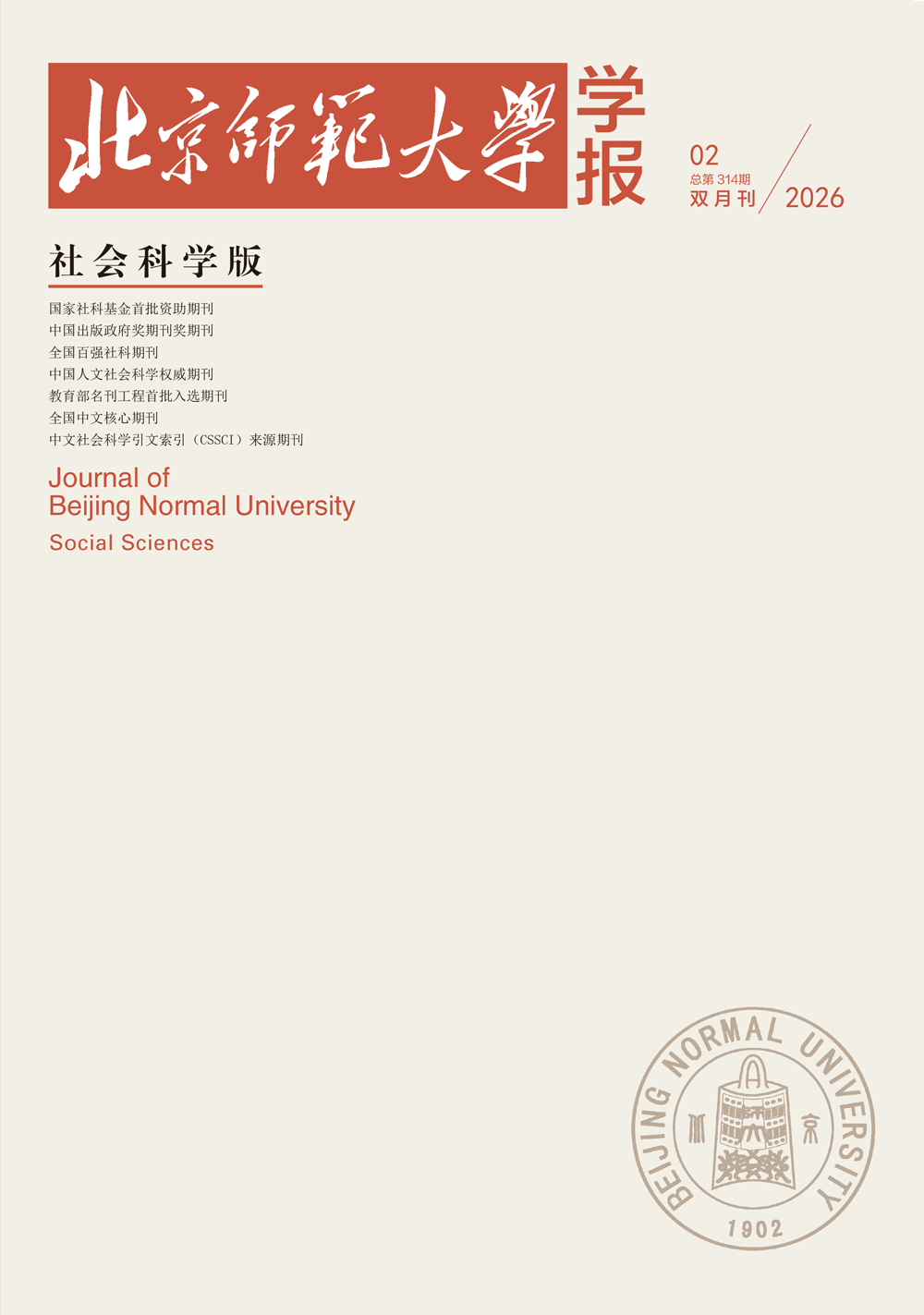
Table of Content
Volume 0 Issue 2 25 March 2026
Studying and Implementing the Spirit of the Fourth Plenary Session of the 20th CPC Central Committee
Advantages,Challenges and Pathways for Boosting Household Consumption during the 15th Five-Year Plan Period
BI Yue, DONG Zhiyong
2026, 0(2): 5-16.
Abstract
(
555
)
PDF
(1403KB) (
2883
)
Related Articles
|
Metrics
Consumption serves as both a fundamental driver of economic growth and a core vehicle for fulfilling people's higher-level aspirations for a better life.As consumption's strategic importance in the national economy continues to rise,China's policy framework for boosting household consumption has demonstrated an evolutionary logic that shifts from a scale-oriented approach to one valuing both scale and quality,and from a demand-side driven model to one featuring joint efforts of both demand and supply side,while closely integrating with the process of economic structural reform and high-standard opening up,thereby becoming an integral part of the macroeconomic governance system.During the 15th Five-Year Plan period,to further boost household consumption,it is essential to not only fully leverage notable advantages in the scale and structure of consumer base,the innovation of consumption objects,the enabling power of consumption tools and the guarantee of consumption environment,but also address pressing challenges such as the differentiation of consumption capacity,structural mismatch between supply and demand side,uneven coverage of consumption tools,fragmentation within the domestic market and the transmission of external risks.Therefore,China should focus on “investing in people” to cultivate high-quality consumption subjects,build a modernized industrial system to create high-quality goods and services that meet people's demand,guide inclusive innovation to establish secure and convenient consumption tools,and prioritize synergistic efficiency to foster a unified and open consumption environment.
An Exploration of the Models and Pathways for Deep Integration of Scientific and Technological Innovation with Industrial Innovation in China
QI Yudong, LUO Tianshu
2026, 0(2): 17-29.
Abstract
(
615
)
PDF
(1285KB) (
7041
)
Related Articles
|
Metrics
The 15th Five-Year Plan period is a critical phase for China to foster new-quality productive forces and break through the bottlenecks constraining high-quality development.Faced with prominent conflicts such as the disconnection between innovation chains and industrial chains,and barriers to factor flows,as well as an international landscape characterized by increasingly fierce global technological competition,the deep integration of scientific and technological innovation and industrial innovation has become a core means to address development challenges and achieve industrial upgrading towards high-end sectors.It is also an inevitable choice for responding to global scientific-technological rivalry and safeguarding the security of industrial supply chains,and bears great significance for building an independent,controllable,safe and efficient modern industrial system.Based on national actual development conditions,combined with the evolutionary laws of scientific and technological revolutions and industrial transformations and international advanced experience,this paper constructs four integration models:chain-based integration,platform-based integration,demand-driven integration,and integration for future industries.These modelsare both independently adapted to different scenarios and interwoven to form a dynamically complementary innovation ecosystem.To promote the effective implementation of such integration,it is necessary to strengthen the dominant position of enterprises in technological innovation and focus on key fields to tackle core technologies.It is necessary to build concept verification and pilot testing platforms to overcome the “valley of death” in the transformation of scientific and technological achievements,create diversified application scenarios and high-level industrial clusters to optimize spatial carriers for integrated development,and deepen institutional reform and improve the financial support system to provide institutional guarantees and resource empowerment for full-chain integration,thereby facilitating the cultivation of new-quality productive forces and the achievement of high-quality economic development.
A New Model for Human Progress
Toynbee's Discourse on Civilizational Forms
DONG Xinjie
2026, 0(2): 30-41.
Abstract
(
516
)
PDF
(1277KB) (
410
)
Related Articles
|
Metrics
Toynbee has greatly expanded the depth and breadth of research into discourse on civilizational forms.His various propositions have,to some extent,solidified the material foundation of civilization research,opened up new explorations of the dynamics of civilization in the Western academic community,and these propositions which are further breakthroughs in “Eurocentrism” or “Westocentrism” have exposed the essence of western imperialist colonial expansion attempting to create a “Westernizing world”.Toynbee holds that world history encompasses both singular civilization as a whole and plural civilizations from different regions,and humanity requires a global political entity.He also used the conceptual categories of primary and secondary civilizations to describe the evolution and iteration of civilizations.However,Toynbee's criticism of Western civilization did not start with an analysis of the capitalist system.His thinking on the logic of civilization evolution that is constrained by religious and spiritual factors,and limited by the ideological constraints caused by the global expansion of Western capitalism is unable to imagine how human civilizations can break free from the shackles of capitalism.This is the core dilemma of the discourse on civilizational forms in the Western academic community.
The Methodological Guidelines and Internal Logic of the Cultural Mission in the New Era
ZHANG Yongzhi
2026, 0(2): 42-53.
Abstract
(
419
)
PDF
(1233KB) (
775
)
Related Articles
|
Metrics
Regarding how to better shoulder the cultural mission in the new era,Xi Jinping Thought on Culture puts forward three interrelated,interconnected and inherently unified methodologies,namely,strengthening cultural confidence,upholding openness and inclusiveness,and adhering to upholding fundamental principles and breaking new ground.This holistic methodology proceeds from the cultural subjectivity that is crucial to the independence of the national spirit,and at the same time contains the fundamental principles of how to realize and consolidate cultural subjectivity in cultural exchanges and cultural development.First,rooted in the subjective power of the cultural organism and manifested as a positive cultural mindset of individuals and communities,cultural confidence constitutes a strong spiritual driving force for the development of the country and the nation.Therefore,strengthening cultural confidence means culturally affirming one's own identity and achieving spiritual independence and autonomy.Second,openness and inclusiveness as a prominent symbol of cultural confidence,are embodied in the symbiosis between contemporary China's cultural self,its historical cultural self and cultural others,the attitude and philosophy of recognizing and respecting the achievements of Chinese civilization and other civilizations in the world,as well as the practical wisdom of building a community with a shared future in the cultural field.Third,upholding fundamental principles and breaking new ground that are an inherent requirement and specific path of cultural confidence,are represented in the dialectical unity between contemporary China's cultural self which adheres to the fundamentals of the system,essential requirements and fundamental stance,and the new methods and approaches to cultural development in the new era.Thus,adhering to upholding fundamental principles and breaking new ground means maintaining the unity of cultural order and cultural creativity,and the unity of the correct path direction and cultural self-renewal,so as to exercise historical initiative inupholding fundamental principles of cultural development and carry out cultural innovation and creation.
Education
Toward the Real World:The Value Examination and Promotion Pathways for Process Quality Assessment of Kindergarten Care and Education Empowered by Human-AI Interaction
ZHU Wenting, HONG Xiumin
2026, 0(2): 54-61.
Abstract
(
597
)
PDF
(3104KB) (
447
)
Related Articles
|
Metrics
The rapid development of artificial intelligence has propelled human society into a new era of human-AI interaction.In the process of building a high-quality education system,it is essential to focus on promoting the physical and mental development of preschool children and to concentrate on process quality to promote the return of kindergarten care and education quality assessment to the real world.In response to the challenges faced by traditional assessment,such as the separation of situational authenticity,the alienation of assessment authenticity,and the barriers of resource authenticity,it is urgent to drive the process quality assessment of kindergarten care and education back to the real world through human-AI interaction.An “environment-person-data-technology” integrated framework was proposed based on the information ecology theory.Through the reconstruction of authentic environment,cross-field collaborative linkage,multi-modal deep integration,and adaptive dynamic support,this study provided new possibilities for achieving the assessment ecology of human-AI interaction such as time-space interaction,scene interaction,data interaction,and decision-making interaction.However,at the same time,vigilance is also needed against the ethical risks brought about by excessive datamation,deprivation of children's subjectivity,and information distortion.Finally,assessment promotion pathways are attempted to be proposed for the process quality assessment of kindergarten care and education driven by human-AI interaction,covering the core value layer,theoretical modeling layer,technical support layer,and application guarantee layer.
Supporting the Construction of an Educational Powerhouse with High-Skilled Talents: Its Logical Mechanisms,Practical Predicaments and Implementation Pathways
YANG Jupeng, SU Yuanxiu, SU Junyang
2026, 0(2): 62-74.
Abstract
(
468
)
PDF
(1291KB) (
815
)
Related Articles
|
Metrics
In the new stage marked by the rapid development of the knowledge economy and China's vigorous efforts to build a great modern socialist country,accelerating the construction of an educational powerhouse is a fundamental requirement for achieving the goals of major national development strategy.High-skilled talents are top-tier ones who possess exquisite skills,embody the craftsman spirit,and are capable of indicatively transforming science and technology,as well as solving complex problems on the front-line of production.They serve as a strong pillar for the construction of an educational powerhouse,as they can fill the “talent gap” to enhance the overall competitiveness of the talent pool,remove obstacles in the transformation of science and technology to promote scientific and technological innovation,implement the strategy of “boosting employment and increasing income” to advance social and people's livelihood development,and bridge “social divides” to support coordinated social development.However,China's cultivation of high-skilled talents is confronted with institutional issues,such as insufficient leverage of enterprises' key role,mismatched school selection and training mechanisms,incompatible social employment mechanisms,and unscientific assessment and evaluation mechanisms.These problems have severely restricted the role of high-skilled talents in supporting the construction of an educational powerhouse.Therefore,China's high-skilled talent cultivation mechanism needs to be reshaped in these aspects including stimulating the enthusiasm of enterprises as main body,transforming the traditional school training mechanism,establishing vocational remuneration that matches the value contribution,and constructing a developmental evaluation mechanism.This will ensure that the cultivation of high-skilled talents meets the objectives of building an educational powerhouse and provides strong support for this endeavor.
Psychology
Research on Trauma Psychology:Current Status,Challenges,and Prospects
ZHOU Xiao, WU Xinchun
2026, 0(2): 75-84.
Abstract
(
578
)
PDF
(1288KB) (
411
)
Related Articles
|
Metrics
Trauma psychology has exhibited a trend of diverse theoretical orientations.Significant advancements have been made in understanding the types,structures,changes and underlying mechanisms of trauma-related psychological responses.A diverse array of targeted intervention strategies and techniques has also been developed to carry out the intervention on posttraumatic reactions.Despite these progresses,the discipline also suffers from several critical challenges,such as the cultural adaptability of existing theories and interventions,limited interdisciplinary integration with fields like big data and neuroscience,insufficient systematic research,and ethical concerns associated with the application of artificial intelligence.Future research should prioritize the development of a culturally contextualized theoretical framework,enhance collaboration across disciplines,adopt a holistic research approach,and establish guidelines for the ethical use of AI technologies.By addressing these issues,trauma psychology research can advance in a more scientific,culturally adjustment,and collaborative manner,offering a robust theoretical foundation and practical insights for trauma-related psychological interventions.
Evidence-Based Interventions for Common Mental Health Comorbidities in Children and Adolescents:From Disorder-Specific Protocols to Transdiagnostic Protocols
HE Qianyun, QIN Yiming, QU Zhiyong
2026, 0(2): 85-97.
Abstract
(
540
)
PDF
(2023KB) (
374
)
Related Articles
|
Metrics
Children and adolescents often present with multiple psychological comorbidities such as depression,anxiety,and post-traumatic stress disorder,posing significant challenges to traditional single-diagnosis-based intervention models.Drawing on a review of relevant studies at home and abroad,this article focuses on two intervention approaches.The first comprises disorder-specific protocols developed for a single presenting problem,with particular attention to their spillover effects on comorbid symptoms.The second comprises transdiagnostic interventions,including unified protocols based on mechanisms shared across comorbid conditions and individualized approaches built on evidence-based modules.Available evidence suggests that disorder-specific protocols show clear efficacy for target disorders,yet in high-comorbidity contexts they are often constrained by limited scope and relatively high resource demands.By contrast,transdiagnostic interventions show promise in improving depression,anxiety,trauma-related stress,and some externalizing problems concurrently.Among them,compared with the Modular Approach to Therapy for Children with Anxiety,Depression,Trauma,or Conduct Problems,the Unified Protocol for Transdiagnostic Treatment of Emotional Disorders in Children and Adolescents appears to offer advantages in structural clarity and dissemination feasibility.In light of China's cultural context and mental health service system,this article discusses pathways for localizing transdiagnostic interventions,with the aim of informing the development of an integrated child and adolescent psychological intervention system that is both scientifically grounded and practically feasible.
Language and Literature
The Impact of Western Chinese Writing Studies on the Early Classification of World Writings
QI Yuantao, JIN Mengting, LIU Huayang
2026, 0(2): 98-106.
Abstract
(
482
)
PDF
(1220KB) (
1268
)
Related Articles
|
Metrics
Chinese writing is important research material for the classification of world writing systems.From 13th century to early 19th century,increasingly detailed studies of Chinese writing in the West promoted the formation and evolution of the world's writing classification.Specifically,from the early Western perspective,Chinese writing underwent a development process from being“discovered” to being “categorized” and finally to having an “independent status”.Initially,the West recognized that Chinese writing is different from alphabetic writing systems in its way of conveying meaning.Subsequently,the West classified Chinese writing and Egyptian hieroglyphs into the same category,with Chinese writing assisting Egyptian hieroglyphs in establishing the dichotomy between “hieroglyphs” and “alphabets”.As research further deepened,Chinese writing was viewed as independent “marks” as well,leading to the establishment of a tripartite classification of world writing systems:Egyptian hieroglyphs,Chinese writing,and alphabetic writing systems.In this tripartite framework,Chinese writing secured its independent status and became typical material supporting new types of writing systems.
The Spatial Implications of “Wuqiong” in
Zhuangzi
:With a Discussion on the Transcendent Meaning of the Character “Wu”
YU Xuetang
2026, 0(2): 107-118.
Abstract
(
530
)
PDF
(1473KB) (
406
)
Related Articles
|
Metrics
“Wuqiong” (infinity) is a defining concept in
Zhuangzi
.The character “qiong” itself implies a spatial connotation,and the spatial dimension of the term “wuqiong” is emphasized in
Zhuangzi
.In short,“wuqiong” signifies transcending limits and boundaries.Specifically,“wuqiong” is a transcendent space created by the subjects' activity of “wandering”,characterized by transcending human affairs,internally dissolving all distinctions,and transcends categorizations.“wuqiong” is a shared spatial characteristic of both the “Dao” and “things”,intrinsically consistent with the idea that “the Dao exists within all things”.It transcends the notion of opposition between the Dao and things.Relatedly,in
Zhuangzi
,numerous terms begin with “wu” that carries not merely the meaning of “nothingness”,but also an connotation of transcendence.Some of the words following “nothingness” represent the problems Zhuangzi addressed,as well as the concepts or methods he sought to transcend and break through.This series of terms beginning with “nothingness” forms a crucial component of the discursive system in
Zhuangzi
.These ideas in
Zhuangzi
exhibit originality among the pre-Qin texts.
The Stylistic Formula of Folk Tales:With a Discussion on the Fluidity of Oral Styles
WANG Yao
2026, 0(2): 119-130.
Abstract
(
430
)
PDF
(1438KB) (
2323
)
Related Articles
|
Metrics
As the prototype of various literary genres,oral literature can be continuously abstracted to psychological structures,and some stylistic formulas can be constructed to promote interdisciplinary dialogue.Taking folk legends as an example,proper names and their density,discrete plots,and closure/anti-closure structures of cardinal sequences serve as morphological identifiers of folk legends,which can outline the stylistic contours of folk legends as a literary genre,namely stylistic formulas.Firstly,the cardinal sequence of folk legends commonly has two kinds of structures:closure and anti-closure,which respectively point to happy endings and tragic conclusions.Secondly,proper names and generic names form a dynamic system that matches each other,and their density differences create different styles of oral literature.Thirdly,the discrete plots of folk legends have specific narrative and psychological functions,which can change the audience's psychological expectations of the genre and transform a fictive folktale into a tangible legend.The three stylistic identifiers of folk legends are not fixed.They can be intensified or weakened,meanwhile the stylistic sense of folk legend also undergoes subtle changes.Due to the fluidity of oral literature,morphological identifiers can be extracted and regarded as variables to assess the stylistic sense.The morphological methodology of oral literature research can lead to an open and dynamic stylistic view and build a bridge for interdisciplinary dialogue.
Economic Growth and Development
The Scale Measurement and Structural Analysis of the Industrial Digitalization in China:2000-2023
SONG Xuguang, LV Shaoyi
2026, 0(2): 131-146.
Abstract
(
514
)
PDF
(1429KB) (
1636
)
Related Articles
|
Metrics
With the growth accounting framework,this paper,categorizing industrial digitization into digital integration effects and digital penetration effects,measures the scale of industrial digitization and analyzes its structural characteristics at national and industrial levels from 2000 to 2023 in China.The findings reveal that the scale of industrial digitization in China has reached 141401.113 billion yuan until 2023,with an average annual growth rate of 22.347%.This scale constitutes over half of the total digital economy and accounts for 11.872% of GDP.The scale of digital integration is greater than that of digital penetration,and the scale of industrial digitization shows a characteristic of “tertiary industry > secondary industry > primary industry”.Industry-specific results indicate that the momentum for digital transformation is better in sectors such as manufacturing,finance intermediation and construction which have experienced rapid growth in their digitalization scale.Conversely,industries like management of water conservancy,environment and public facilities,real estate,culture,sports and entertainment have progressed slowly in terms of digitalization.Regarding disparities in digitalization,the differences in industrial digitalization across China have been decreasing annually.The disparities within the secondary industry have diminished year by year,while those within the tertiary industry have shown an “S” shaped trend,initially rising and then stabilizing.This article enhances the understanding of the scale and trends of industrial digitalization development in China and provides data support for formulating and adjusting policies related to the structure of industrial digitalization,promoting the coordinated development of digital industrialization and industrial digitalization.
The Impact of Resource-Based Cities Transformation on Green-Growth Efficiency
ZHANG Jiangxue, GAO Linhan, CHEN Chaofan
2026, 0(2): 147-160.
Abstract
(
464
)
PDF
(1271KB) (
1591
)
Related Articles
|
Metrics
Promoting the transformation and upgrading of resource-based cities and moving towards a new stage of green growth are the key paths to achieving high-quality development.Based on a quasi-experimental design,empirical tests were conducted on the impact and mechanism of the transformation policy of resource-based cities on green-growth efficiency during 2009-2020.It is found that the transformation policy of resource-based cities has a significant positive impact on green-growth efficiency.However,due to possible reasons such as exit barriers to traditional production capacity,incubation cycles of emerging alternative industries,and low policy implementation efficiency,the impact has a certain time lag,with the policy effect having gradually strengthened since 2016.The results of the mechanism and heterogeneity test show that the transformation policy of resource-based cities can promote the green-growth efficiency by optimizing the industrial structure and alleviating the resource dependence,and the most obvious effect is in declining cities,of which the policy promotes the optimization of industrial structure and adjustment of resource dependence.Further research reveals that from a spatial perspective,both the transformation policy and green-growth efficiency of resource-based cities demonstrate significant spatial spillover effects.To promote the green development of resource-based cities,it is necessary to formulate long-term support policies at the national level to promote sustainable prosperity,necessary to emphasize the synergistic mechanism effect of optimizing industrial structure and adjusting resource dependence and necessary to implement differentiated transformation strategies tailored to different types of resource-based cities.
News
More...
Journal Online
Just Accepted
Current Issue
Archive
Read Articles
Download Articles
Most Cited Articles
Email Alert
RSS
Download
More...